Today I visited hell.
It wasn't officially on the itinerary--at least not by that name. But it was searing hot, there were demon-like characters, and much physical suffering.
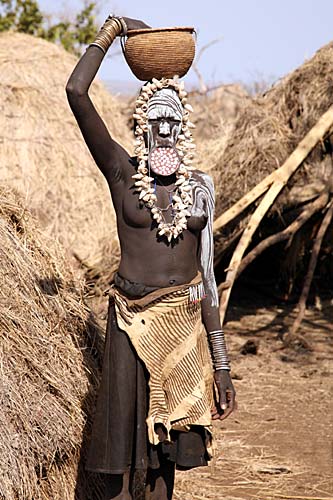
We'd been hearing for days about the Mursi tribe--the one where women split their lower lip and insert a round metal plate. As we were repeatedly told, the Mursi are neither fun nor friendly. And while they've kept their distance from the outside world--largely in part because their territory is a vast expanse of remote national park--they nevertheless have turned their small contact with foreigners into an art form of extortion. Pictures equal money. No exceptions.
Skipping the Mursi would be out of the question. They're the most famous of all the indigenous Ethiopian tribes. But since photography was a major goal of this trip and the opportunities at the Mursi would be limited, we also planned to drive further into the wilderness to reach the Bodi tribe. Less visited, more friendly: better for pictures. Never mind the fact that they're suspected of cannibalism.
My problems actually began the night before. 2:07 AM, to be precise. I don't know if it was the tuna salad I ate for dinner or the fact that I accidentally drank tap water the previous afternoon, but my stomach was in revolt. I spent the following three hours vainly attempting to quash the rebellion (while also battling the occasional mosquito attack). By 4:30 AM the battle was lost. Dinner was deposited in the trash can at the side of my bed.
I should point out here that this woke Pascal up, whose first concern after turning on his flashlight was not my health, but the state of his bag right next to the trash can. Apparently he's forgotten about the time he lost it all over my sleeping bag (with me in it) back in Ecuador.
Anyway, food poisoning. No big deal if you've done any kind of third-world travel. But this one was the gift that kept on giving.
My stomach still feeling tremors, we stopped for breakfast on the way to the national park, right at the break of dawn. Our guide actually woke up the breakfast shop owner (which looked more like someone's backyard than an actual restaurant), and he was kind enough to cook up some omelets for us.
As soon as they arrived, the smell of fried eggs hit me like a blow to the gut, and I repaid his kindness by redecorating the ground in his backyard. Complete with impressive sound effects. I think his entire family came out to watch.
At this point, a wise course of action may have been to delay the excursion to see the Mursi. Not going to happen. Sick stomach or no sick stomach, I wasn't about to blow our itinerary just because one meal didn't sit well.
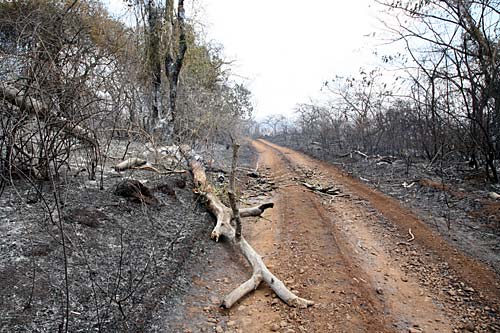
So we drove into the national park. The term "drove" should be interpreted very loosely here. All the main roads we've seen since Arba Minch have been dirt or gravel, with all the potholes, ruts, dips, rocks and obstructions that come with. And this was no main road. It was, in fact, a great way to simulate on four wheels the Tilt-a-Whirl from your local Carnival. Up, down, twists, turns, rocks, holes--you name it. This also explains why there are no--and I repeat no--regular cars here in the south. If it's not four wheel drive, it doesn't make it.
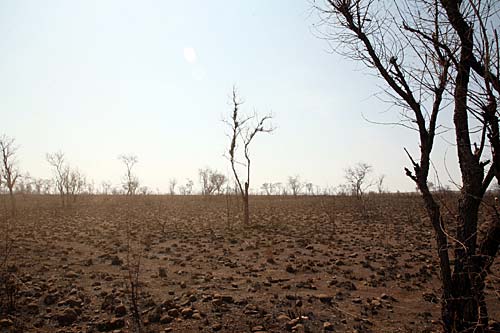
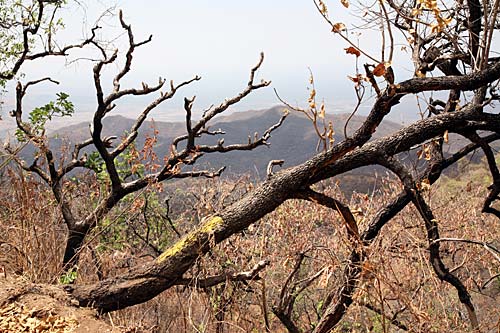
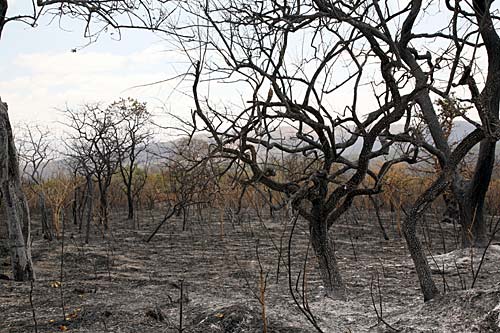
How my stomach made it is a different story. It took us three hours to drive some 30 miles, and as I was mercilessly jostled around my nausea completed its hold on my reality. I vaguely remember that we had to pick up an armed escort at the entrance to the park (like I said, the Mursi are not known for their hospitality). And that the dry, mountainous terrain was quite striking in its arid beauty.
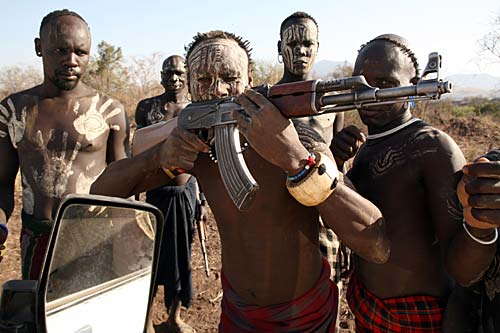
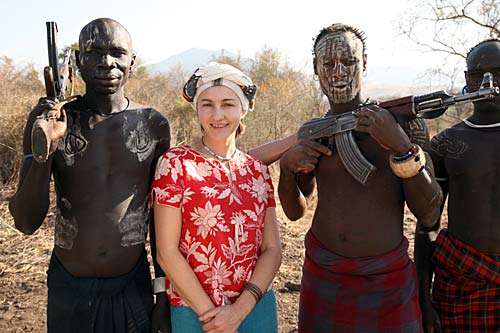
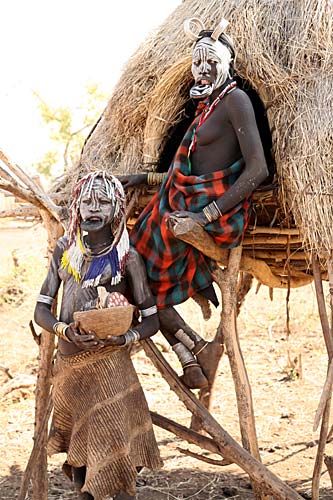
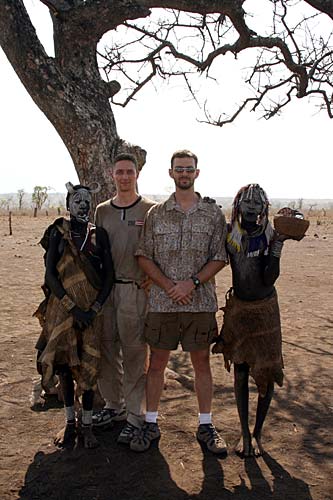
We met our first Mursi at a road checkpoint at the entrance to their territory. About a half-dozen naked men with jet-black skin and white, chalky body paint, large hoop earrings, and lots of attitude. Some had small loincloths; others had machine guns. Indigenous they may be, but the Mursi are a warrior tribe, and war with other tribes is a fact of life.
It wasn't too far from the Mursi settlement that I lost it again, for the third time. A little extra moisture for the sun-baked earth.
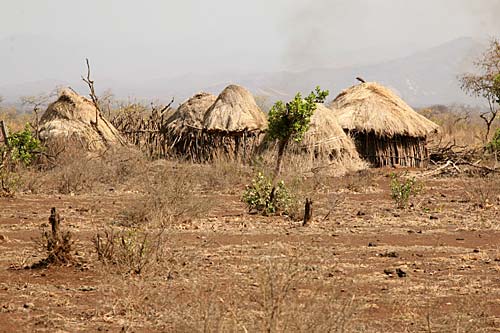
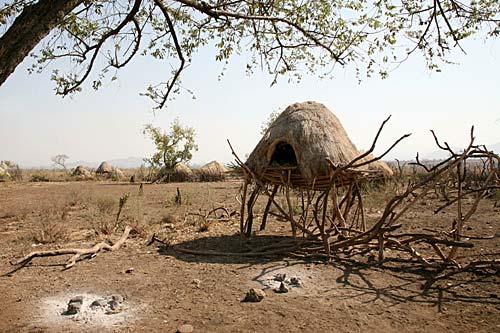
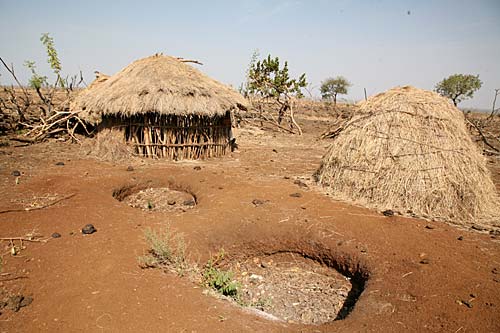
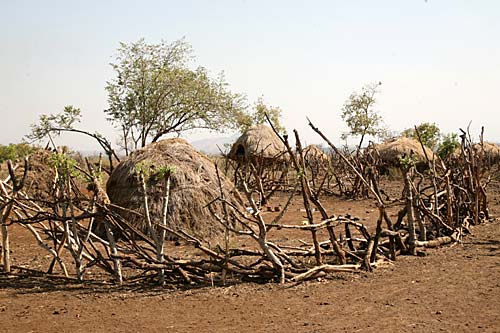
The Mursi village rested on a parched plateau overlooking the valley. Small huts with thatched roofs, some on stilts (to escape the rats). Maybe a dozen huts total, and an unpleasant odor of decay and animal feces.
And then the Mursi women greeted us. Yes, they were topless, but frankly it's hard to notice something like that when each woman also has their lower lip sliced off in the middle and stretched unnaturally so that it hangs down past the chin, exposing teeth and gum. It may look interesting once they have the plate inserted, stretching the lip out to about the size of a small tennis ball, but remove that plate and you have some seriously unappealing dangling lip flesh.
I tried to take pictures. I really did. But I think I only got about a half dozen total. Apart from the constant hostile demands to take their picture for money, and the fact that the whole scene was more than a little disturbing, I was also completely sick. Nauseous, weak and dehydrated. I hobbled back to the boiling refuge of our car and was relieved to leave.
We couldn't drive on to the Bodi tribe. I was too sick, and the sun was reaching its unforgiving high point, baking all below to an unrelenting crisp. Our guide Kapo believed I had malaria, as on the last round I'd mostly heaved bile. I suspected some brain fluid as well. But I hadn't been inside the country long enough (malaria has a minimum seven day incubation period).
Malaria wasn't a concern for me. But heatstroke absolutely was. I hadn't eaten in almost 24 hours and couldn't keep any water down. Even a little sip of water would roil my stomach in waves of nausea. I emptied out again just a few minutes later. I couldn't digest water. In the desert heat, this was a very dangerous combination.
At my low point, when we were still 3 hours away from any kind of civilization and the combination of oppressive heat and loss of all bodily liquids had completely sapped me of my strength, I actually wondered whether I would make it. It was perhaps a silly thought--or at least it's easy to think so in retrospect. But it was very real at the time, and I remember making a small prayer to St. Raphael, the patron saint of lost causes, to help me through the day. And then my body started to accept small doses of water.
I'm not fully recovered yet: my legs are wobbly and eating a full meal is out of the question. But we're back in action and ready for the next day's adventure. I've seen the famous Mursi and battled my own demons for the opportunity, and now it's time to see what else this amazing country has to offer.