It was a one-in-a-million occurence, I've been told. Like getting struck by lightning. Be that as it may, the thing about one-in-a-million events is that they're 100% real to that millionth person. And this time that person was me.
It was shaping up to be a rather uneventful day. At least compared to previous days on our action-packed tour of the south. Already on the return leg heading back towards Addis Ababa, we'd spent the night in the hard-working town of Konso. Morning was spent viewing two low-key markets on the outskirts of town, followed by several dusty hours of driving to reach the southern trading nexus of Arba Minch. And our first glimpse of a paved road in over a week.
But the most exciting thing about Arba Minch wasn't the return of the occasional paved road, but mango juice. Freshly squeezed. Oh, how we'd craved that delicious and refreshing taste in the unrelenting dry heat of the south. After a week where our constant beverage was tasteless bottled water just near its pre-boiling point from sitting in the car, with the occasional luxury of a lukewarm Coca-Cola in the evening at the local restaurant, fresh mango juice had consumed our hydration fantasies. We even sang an improvised ode to mango juice on the drive up to Arba Minch. And unlike some fantasies, this one lived up to its expectations.
So it was with content hearts and blissfully refreshed spirits that we headed north after lunch towards Awassa, a five-hour drive that promised nothing of particular interest nor any scheduled excitement. Pascal and I promptly fell asleep, having long ago mastered the acrobatic art of full deep sleep while sitting and being shaken about by the trying road conditions. We expected nothing but a dull ride until our scenic lakeside destination of Awassa.
We were wrong.
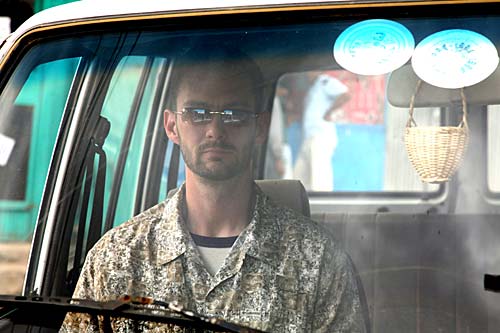
Ten miles short of Sodo, on a silent stretch of road, our driver Tarekegne screeched our car to a halt, jolting Pascal and I awake. I was in my usual post in the front seat, and when my eyes snapped open it took my sleep-induced mind a moment to register what I was seeing.
Three men on the road in front of us were running directly towards our car. They had hoods over their heads. And they were pointing machine guns straight at us.
"Robbery," Tarekegne said.
The first gunman reached Tarekegne's door and jerked it open. He screamed something in Amharic and grabbed Tarekegne's cell phone. And wallet. After that I'm not sure what happened to Tarekegne; the barking of instructions in Amharic continued, but my observation of these events was interrupted by loud banging on my own door. The second gunman was pounding my door with his machine gun, barrel pointing right at me. One squeeze of the trigger and my whole midsection would be gone.
I opened the door, and he pointed the machine gun straight at my chest. Then screamed something in Amharic. I have no idea what he said, but I got the point. I reached into my pocket (the one where I kept the lower-denomination bills) and handed over all of its contents.
Then I got distracted by the events in the back. While the third gunman had kept a flanking position on us some ten feet from the car, ready to shoot at any sign of trouble, the first gunman moved back and yanked Pascal's door open. He was now yelling at Pascal and Leila in the backseat.
"He wants money, cameras," Tarekegne said.
As Pascal reached into his pocket to find his money, the gunman reached across Pascal and grabbed his digital camera, which was on the seat next to him. Seeing this, Leila quickly pulled out the memory card from her camera and tucked it close to her body. My own camera was in my camera bag on the floor in between Tarekegne's seat and mine, but at this point I was more concerned with the bag at my feet. Not only did the hard disk inside hold all the pictures I'd taken on this trip, but my passport, extra cash and plane tickets as well.
My own gunman was still shouting at me, and as I answered him in English as a stalling tactic and mild distraction, I shoved my bag with my leg as far away from the door as possible.
Behind me, there was commotion as the first gunman reached across Pascal and grabbed hold of Leila's bag, which also held all of her essentials. Instead of letting him take it, Leila grabbed the other end of the strap. They fought over it briefly.
It was the next car that saved us. Seeing another car approach, the gunmen quickly abandoned ours and moved to intercept the new vehicle.
In an act of daring, Tarekegne got out of the car and asked the first gunman as he was leaving to give back the phone and camera. The gunman shouted at Tarekegne to get back in the car or he'd shoot him. Not understanding what either of them was saying, I was also shouting at Tarekegne to forget the stuff and get back in the car and drive off while we had the opportunity. He did, and we quickly sped away.
It turns out we were lucky.
We caught up with the red Isuzu pickup that had been ahead of us. They had been robbed as well. Their window was smashed in and the man in the passenger seat had been struck in the head with the butt of the rifle by one of the gunmen. They had taken all their money and possessions. Everything, including their change of clothes. All they had left was what they were wearing.
It was the oncoming car that spared us a similar fate. Without the extra minute needed to clean us out completely, the gunmen had made off with only some of our money and Pascal's digital camera. It could have been much, much worse. We never found out what happened to the car behind us.
We stopped at the police station in Sodo to report the incident of course. They dispatched a police pickup to the scene, some half-dozen heavily armed police officers in the back. From what I've been told, if they catch the bandits in the bush, they'll most likely be killed on the spot. Apparently this saves everyone the trouble of incarceration and trial.
From there, we continued our journey north to Awassa. In our peaceful resort hotel by the lake that evening, I had spaghetti and meatballs for dinner. With a large glass of freshly squeezed mango juice.