Last night we slept in the Sahara.
Not in a dingy hotel room in an oasis in the middle of nowhere in the Sahara, like the night before, but on an actual sand dune, under the stars.
It’s actually quite pleasant at night, as the temperature drops to a balmy 80 degrees or so, a stark contrast to the furnace-like daytime heat.
The only discomfort was the blowing sand, of which there was plenty. Pascal apparently slept horribly because it took him a good 5 hours to come to the realization that one is better off sleeping with the blanket on top of the head. So he chewed sand for the bulk of the night…
But I’m getting ahead of myself.
We arrived in Cairo on Sunday morning around 1:30 AM or so, some 36 hours after we left Fairfield. While a long trip, the good news was that 12 of those hours were a layover in Amsterdam, during which we were able to go visit the picturesque downtown.
Pascal’s friend from the Army met us in Cairo, and we stayed in his apartment the first night on an island in the middle of the Nile. Since our sense of time was completely out of whack (Egypt is 8 hours ahead of Central Time), we drank Egyptian tea outside a small street café while Aaron regaled us with stories from his year in Egypt at the American University in Cairo (AUC).
For instance, in the beginning of the war with Iraq, Aaron explained to us how a group of students from the AUC—including some Americans—protested against the war by demonstrating in the streets. As Aaron watched from the roof of the university library, the National Police arrived on the scene and promptly began to beat the protesters with bamboo sticks. Welcome to a police state.
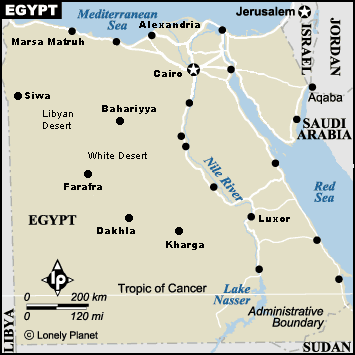
With just a few hours of sleep, we left Cairo in the early afternoon and headed due West for the coastal city of Marsa Matruh, where we spent the night. Between the constant battle with a horde of vicious Egyptian mosquitoes and the ridiculously loud gurgling and bubbling of Pascal’s stomach, I hardly slept at all.
That night, we also discovered an interesting cultural difference: Egyptians don’t believe in toilet paper. Apparently this is not considered clean in their religion—they have to use water.
In most instances, this means that toilets will have—instead of a roll of toilet paper—a little tap and hose for this purpose. But our toilet had a rather unique contraption: a water squirter.
This metal plumbing hung directly inside the bowl, right in the middle, with the opening facing up. Turn on the tap and water shoots up an impressive six feet into the air (understandably, neither Pascal nor I wanted to try it live) right from inside the bowl. Not for the faint of heart, I’m sure.
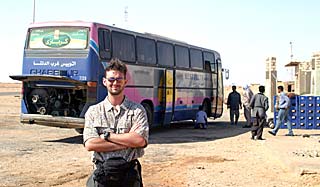
In the early morning we boarded another bus and traveled through desert (no mistaking it: only sand and rocks to be seen for hundreds of miles) to our destination: the Siwa Oasis.
Fed by underground water springs, this patch of vegetation amidst endless arid rock and sand dunes—just a stone’s throw away from the Libyan border (check your atlas!)—has been a haven for travelers for thousands of years. In fact, yesterday we saw the tomb of what is believed to be Alexander the Great.
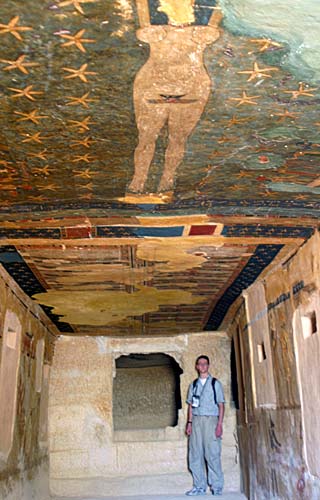
We also saw—get this—real live mummies!! There’s this hill called the Mountain of the Dead with literally hundreds of tombs dating back countless centuries. In one of these were the mummified remains of several people, including a baby and a nasty-looking severed head that still had much of its hair left on it.
It was a ghastly sight, really. One tends to think of mummies as being completely wrapped up so that you only see the outline of the body through the cloth, but the reality is that over time the wrappings disintegrate or I don’t know what so that what you actually see is undeniably human in appearance.
Their color is gray to black, and what’s left of facial features is warped (melted is the description which seems to best fit) in an _expression I can only describe as distinctly not happy looking! Kind of like the Orcs in the movie Lord of the Rings.
In a number of tombs there were miscellaneous human bones here and there, and a team of local Egyptians were busy excavating yet more tombs as we went through the site. Throw in the hieroglyphics we saw on some of the tomb walls and I think we fulfilled just about every stereotype for Egypt in just a few short hours!
After visiting a number of other interesting sites (I’ll let the pictures do the talking on those), we headed out to the Sahara last night in a hardy old Land Rover with our local guide Fathy and Sayeed, the driver.
I think the video of this will give a better depiction of how much fun this actually was (and what a pain it is to get stuck in the sand—everyone push!)
Right now Pascal is passed out—a combination of too little sleep and an upset stomach. This afternoon we begin our long journey: an 800-mile adventure that will take us through the heart of the Egyptian Sahara and a total of 5 different oases before reaching the Nile at Luxor.
Have to go now--the desert awaits!
Cheers,
Gabriel