Today, Pascal learned all about altitude.
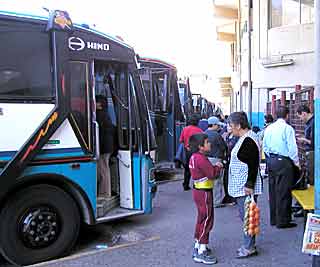
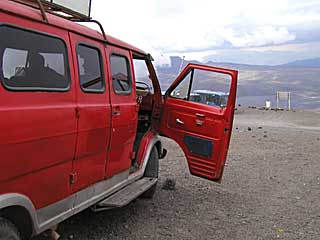
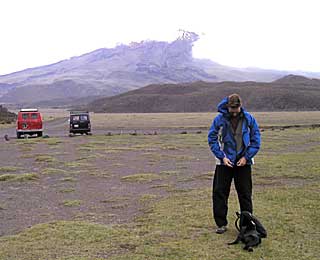
We grabbed an early morning bus from Quito to the entrance of the Parque Nacional de Cotopaxi. There, we hired a rickety red Ford van that saw its heyday sometime back in the mid-70´s to take us deep into the park.
This beat up old relic bounced, shook and rattled so much on the 20 miles of rocky trails that I half expected it to simply disintegrate into a heaping pile of scrap metal at any time. But the laws of mechanics are simply different in third-world countries, and vehicles appear miraculously able to tolerate enormous abuse practically indefinitely.
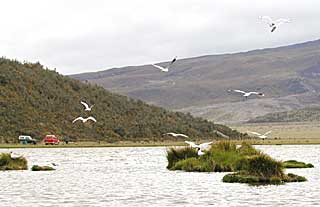
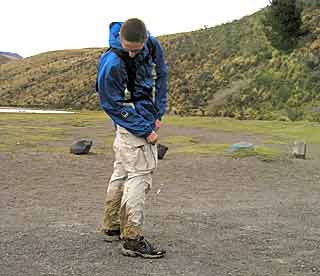
At the foot of the Cotopaxi volcano, we briefly visited the Limpiapungo lake (altitude: 12,500 feet). There´s not much to say about this lake except that Pascal spent a good half hour running around in the muck (then lying down in it) to take pictures of seagulls. This terrorized the poor birds, but Pascal appeared to have loads of fun, with both the pictures and muddy shoes/pants to prove it!
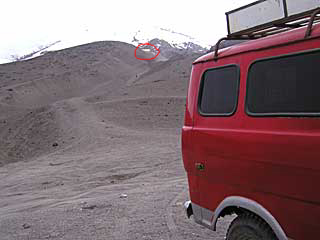
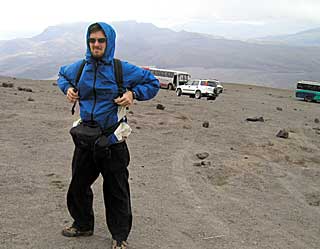
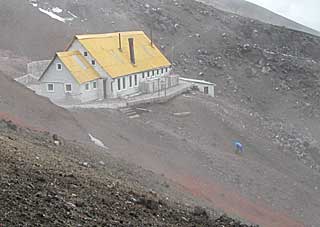
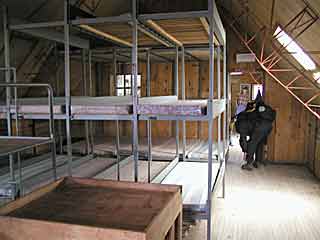
We parked a little higher on the mountain (14,100 feet), then proceeded to climb on foot to the Jose Ribas refuge. At 15,750 feet, this refuge (from which summit expeditions to the top of the volcano start) is at the same altitude as Mt. Blanc, the tallest mountain in the Alps. That makes the refuge 1,250 feet higher than any mountain in the continental United States.
That´s high.
So although we only had to climb 1,640 feet (roughly 164 stories) from the van to the refuge, at this high altitude your body is straining to get enough oxygen to function. So while the yellow-roofed refuge looked deceptively close, I told Pascal it would take about half an hour to climb up.
Pascal looked at me like I was a total wuss, grinned, and said "Yeah, right, I´ll do it under 20 minutes easily!"
I suppressed a smile and responded. "Tell you what, Army boy, I´ll start my stopwatch right now. We´ll see exactly how fast you can climb this thing!"
He accepted, and--to my utter disbelief--started sprinting up the hill! We´re at over 14,000 feet and numbnuts is sprinting!
I started slowly making my way up myself, slowly and surely, and Pascal hadn´t even gone up more than 60 feet when I saw him stop, stand for a moment, and collapse onto his butt.
"What´s up?" I asked as I passed him.
"I...[pant][pant]...need more...[pant][pant]...air," he responded.
That about sums up mountain climbing, doesn´t it? If it weren´t for the lack of oxygen, anybody in reasonably good shape could manage to climb a few thousand feet and summit the world´s tallest mountains. But the physical demands are severely exacerbated by your body´s inability to get enough oxygen to the muscles. Kind of like trying to sprint in water--the movement may be the same, but the effort needed to get the same result are drastically different.
How did this end? Pascal made it up in 25 minutes, 2 minutes after his "old geezer" of a brother. To his credit, I´m sure Pascal could have made it up several minutes sooner as well had he not totally overexerted himself in the beginning.
Actually, Pascal´s experience today is parallel to mine in Ecuador last year. Young, fit and in great shape, it´s easy to assume that your physical fitness can overcome any obstacle. As Pascal learned today, and as I almost lost my life learning last year, no amount of physical conditioning can overcome proper altitude acclimatization.
At the refuge, we relaxed a bit and talked to a French Canadian who is planning to summit Cotopaxi tonight. We discussed my summit attempt last year when I got high-altitude cerebral edema (HACE) and he recommended I get a prescription for dexamethasone before we climb, in case it happens again. That´s a good call, and I plan on getting that tomorrow.
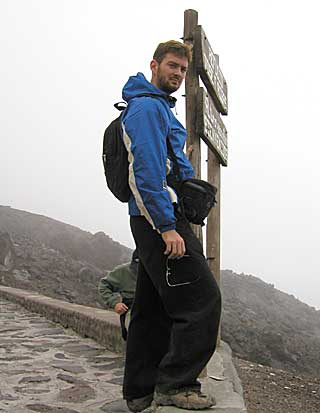
While we were talking, Pascal started experiencing the symptoms of altitude sickness: headache, nausea, weakness, etc. Note that these are mild symptoms--nothing to worry about unless they start getting progressively worse.
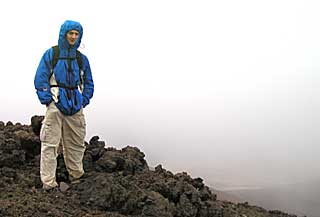
Keeping a close eye on Pascal´s symptoms to make sure they weren´t worsening, we walked around the refuge for about an hour. We were shrouded in dense clouds most of the time, but the occasional burst of sunlight and visibility afforded us some spectacular views of the countryside below and the glaciers we will be climbing a couple days hence.
We returned to Quito in the early afternoon. While I think that much of Pascal´s altitude sickness today was due to his initial overexertion, I want to make sure that both he and I will be fit to climb before our summit attempt on Thursday.
To help with this, we are going to go back to the refuge tomorrow and will spend Wednesday night there. Our guide will meet us there on Thursday with all of the climbing equipment (ice axe, climbing boots, crampons, gaiters, head lights, glacier goggles, ropes, belays, etc.)
This will effectively give both of us an additional 24 hours in the 15,000 foot range to acclimatize. It´s very important that we´re both comfortable at this altitude for our climb to the summit at 19,350 feet to be both feasible and medically safe.
At this point, the plan is for us to start our climb to the summit Thursday night (actually, Friday morning at 1:00 AM). Should either the weather or our bodies not cooperate with this plan, we´ve reserved our guide for an extra day so that we´ll have Friday night as a backup climb night.
Alrighty. My next email--depending on when we climb--may not be until this weekend (we return to the US Saturday evening).
Wish us luck, and Happy Thanksgiving to all!
Cheers,
Gabriel