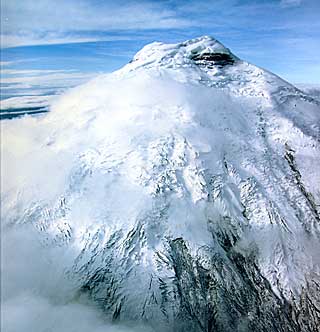
The last two days have been ridiculously intense. Here's how Pascal and I fared in our bid to summit Cotopaxi, the world's tallest active volcano at 19,350 feet
PART 1: Pascal Gets Sick at the Refuge
We climbed up to the refuge (15,750 feet) on Wednesday afternoon. This time, Pascal didn't try to sprint! ;-)
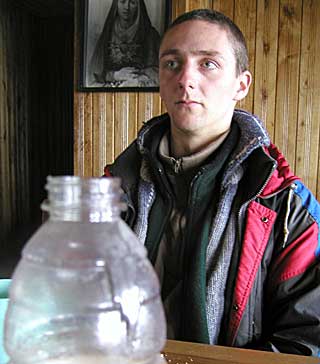
Although Pascal was acclimatized to about 13,000 feet, he began to feel the effects of altitude sickness early on in the evening, with a strong headache and general unease.
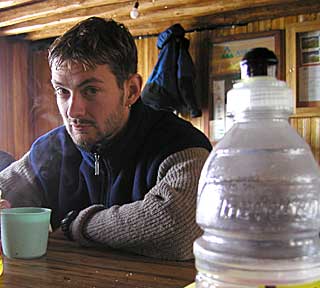
The refuge has a common dining area and kitchen downstairs, while the upstairs has two rooms packed with triple-decker bunk beds (about 50 beds per room). By 7:30, Pascal was feeling relatively miserable and unfurled his sleeping bag in one of the bottom beds to sleep it off.
Our plan was to spend the entire Wednesday night at the refuge and climb Thursday night, allowing us an extra day to acclimatize to the high altitude. However, every single other person in the refuge that night was planning on climbing that very night, so no one wasted any time getting to bed, since they'd have to awaken at midnight to gear up for their climb. By 8:30, everyone was in their beds and the refuge went dark--I grabbed the bed nearest to Pascal.
One of the unusual effects of high altitude is that it causes irregular breathing, especially while sleeping. This is in fact, why altitude sickness typically gets worse if you sleep at high altitude, as opposed to just visiting and returning to sleep at a lower altitude (thus the climber's maxim, "climb high, sleep low").
Despite having taken the Diamox to help with this, Pascal's irregular breathing was highly noticeable. He'd range from heavy Darth Vader-style breathing to shallow mini-breaths to weird moaning breaths to simply forgetting to breathe altogether for a while--all in a matter of half a minute. The latter was particularly freaky (although I'd heard of it when researching altitude acclimatization, to have your own brother forget to breathe right next to you is quite alarming!)
Since proper hydration is a key element in fending off altitude sickness, I'd brought up a thermos full of hot water for us to drink from throughout the night. Shortly after 9:00, Pascal groaned. "I need water," he said.
Since I'd only recently managed to ignore Pascal's possessed breathing patterns and finally fallen asleep myself, I was not eager to fully wake up. "There's the thermos with water on the floor--can you get it yourself, or do you need help?"
"Urgh...(moan)(groan)...can you pour it?" he whispered back.
I filled up the cup and handed it to Pascal. Then, he landed his bombshell.
"Uurgh, I'm going to throw up in the cup." He barely finished his sentence when the first wave hit.
Our two single bed mattresses were literally side-by-side, and I was not 10 inches from Pascal when he said this. With uncanny speed based on instinct for self-preservation, I grabbed my sleeping bag and threw myself against the wall, as far from Pascal as I could.
Thank God I did. The cup I'd given him was already full of water, so you can imagine the effect. He got it all over himself, his sleeping bag and mattress. Then, as his convulsions increased, Pascal edged over the bed and let loose all over the floor. My arm shot out and saved my boots from flooding just in time!
Needless to say, Pascal wasn't feeling well.
The most annoying feature of the refuge was that you had to go outside and into another building to use the restroom. It was cold and very windy as I helped Pascal over to the restrooms. After wrapping up in the restroom but before getting back to the refuge, Pascal found two more opportunities to unload the brie, bread and blue cheese we'd had for dinner on the cobblestones between the two buildings.
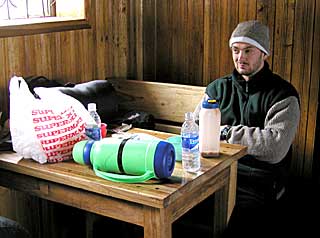
Back inside, we sat in the downstairs dining room--unlit since they turn off their generator at night. I boiled some water while Pascal held his head between his hands, a trash can within easy reach in case of emergency.
Pascal was in a bad shape, and we both worried about how serious his condition was. I constantly asked him about his symptoms to make sure they weren't getting progressively worse (in which case we'd have to make an emergency dash to a lower altitude).
They weren't, but they were still quite unbearable. Pascal was still highly nauseous and weak, and said that any movement of his head aggravated his major headache to the point of tears, a sensation he described as thousands of tiny needles attacking his brain.
We stayed downstairs for a good hour while I forced him to drink one cup of water after another to ensure proper hydration. While his symptoms weren't getting any better, they weren't worsening either, and at about 10:30 Pascal was so weak and tired that I brought him back upstairs to sleep.
At midnight, as six climbing teams rose to gear up for their summit attempt, I asked some of the guides about Pascal's condition--specifically, to find out if he was in any medical danger or might need immediate descent. They didn't think so, which was a relief.
I woke up often to check on Pascal and help him drink some water. I also had to use the restroom about a dozen times since I'd had so much water myself when we got to the refuge to avoid dehydration and altitude sickness. The windy storm outside was intensely fierce, and as it turns out none of the 6 teams were successful in their summit attempt.
PART 2: Preparations for the Climb
In the morning, Pascal looked like a miserable shell of his normal self. While he was feeling slightly less sick, it was still bad. I made arrangements to have him driven down to stay at a hotel 3,500 feet lower. That would speed up his recovery and give him the opportunity to get better for a climb on Friday.
I spent the day Thursday relaxing at the refuge. The climbers from the night before were quite dejected in their failed summit attempts. Some decided to stay another day to climb Thursday night.
At 4:00 my guide arrived. It turns out Ivan wasn't just any guide: he was the top mountain climber in Ecuador, and a national legend to boot. In 1999, he became the first Ecuadorian to climb Mt. Everest, and he subsequently climbed it twice more without the use of oxygen. He also climbed K2, a climb so difficult and dangerous that only 178 climbers in the history of the world can claim credit to this.
The other guides at the refuge that were there for other climbing teams pretty much hero-worshipped Ivan, and many climbers asked me how we'd managed to hire him as our guide. I could only point to my Lonely Planet guidebook, which recommended the climbing agency he owns as one of the best in Ecuador, and it turns out he'd just returned from Nepal two weeks ago and wanted an excuse to climb Cotopaxi this weekend for fun. Amazing.
Apart from finding out I'd inadvertently hired the Michael Jordan of high-altitude mountain climbers as a guide, my other big surprise was to see Pascal had returned as well. He was chipper and fresh as a pickle--turns out a good 2 hour nap at 12,000 feet was just what he needed, and he felt great. Ivan had stopped by to see Pascal on the way to the refuge and also checked his pulse before determining that he should be able to climb.
Frankly, although I knew the lower altitude would do him immediate good, I hadn't expected to see him until Friday. But since weather conditions were on the up and up, I was glad he was there and that we could attempt our summit attempt together.
PART 3: Climbing Cotopaxi
Climbing a 19,000+ foot mountain is not child's play, and requires serious mountaineering experience and equipment. Thankfully, the experience came from one of the best mountain climbers on the planet, and at midnight we donned all the equipment to make the climb possible.
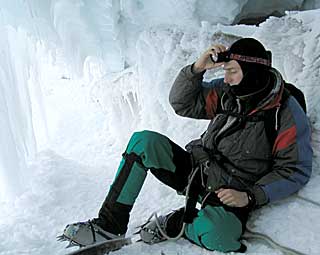
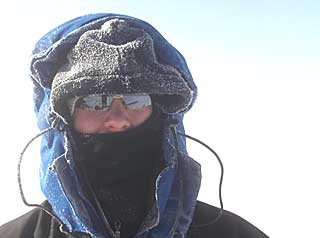
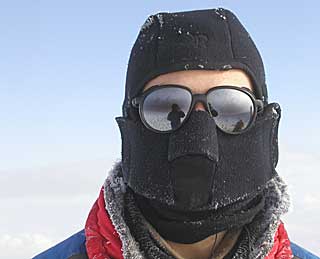
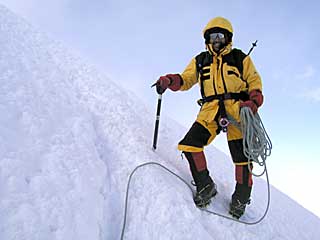
Apart from the usual multi-layered clothing, this included special climbing boots, crampons (spikes that attach to the boots to provide traction on snow and ice), a harness so that we could each be roped together during the climb (that way if anyone falls into a crevasse or slips and starts sliding down a steep glacier, the other 2 can stop him), ice axe (to help provide stability on steep ascents/descents and to dig into the glacier to stop your slide should you slip), head light (our climb starts at 1:00 AM for best snow conditions, so the light provides illumination during the night portion of the climb) and special glacier goggles (our descent should take place during daylight, and if it's sunny the extreme brightness of the snow and ice could cause snow blindness without these extra-strong goggles).
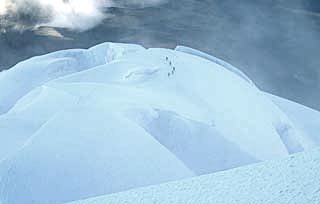
At 1:15 AM on Friday morning, Pascal and I left the refuge with Ivan and began our ascent. An experienced American climber from Colorado had left 20 minutes earlier with Ivan's climbing partner as a guide, as well as another duo of two experienced French climbers and their guide. After us, two seasoned German climbers (sans guide) and a group of eight Austrians and their guide.
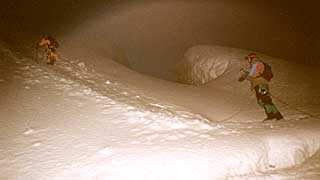
The first part of the climb to reach the glacier was relatively straightforward. Ivan set a good pace, and the lights from other climbers' head lamps above or below us cast eerie glows on the white mountain landscape.
We reached the glacier around 2:30 AM and attached our crampons and roped together--it was all glacier from now on. Neither Pascal nor I were feeling particularly well (we were cold and nauseous), but we were determined to go forward.
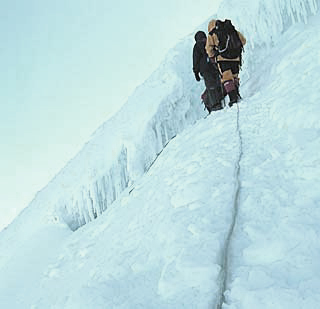
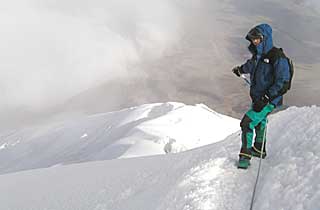
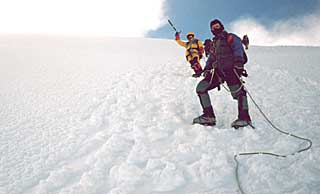
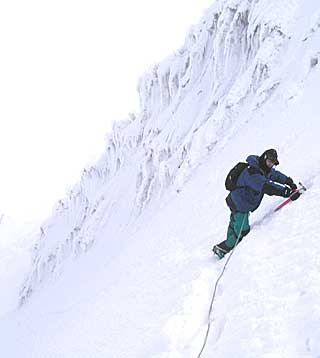
I don't think either of us had expected the glacier ascent to be so steep. Even with crampons providing solid traction in the snow and ice, we often found ourselves climbing steep slopes on our hands and knees for fear of falling backwards and plummeting back down the mountain.
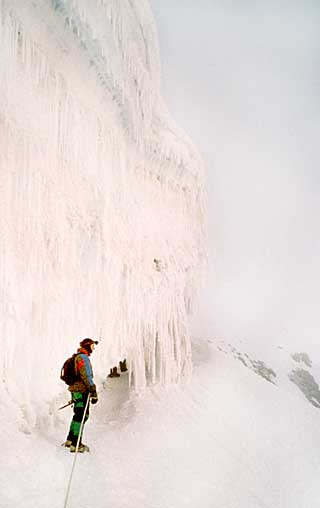
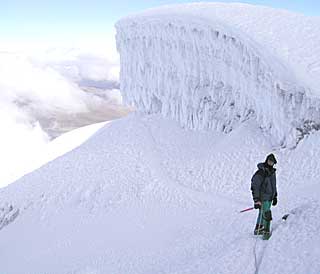
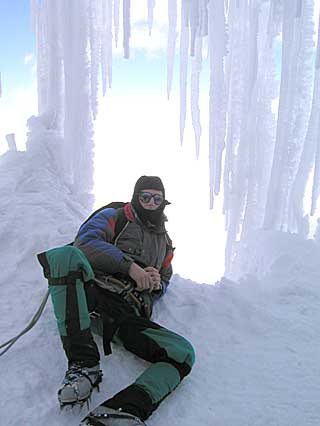
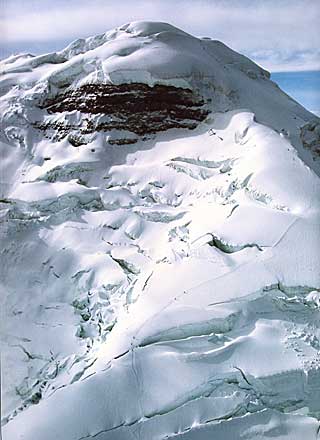
We passed crevasse after crevasse, some with snow bridges so narrow one wondered why they didn't collapse under our weight. Despite their danger, the crevasses were also strikingly beautiful, with long stalagtites, curved snow walls and openings, and depths only left to the imagination.
Another benefit of climbing at night was the incredible night sky. I don't think I've ever seen so many stars, or so bright. And on two occasions I saw shooting stars--but I was too preoccupied with my climb to make a wish!
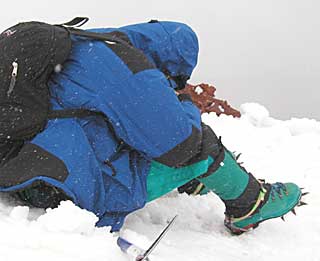
At about 4:00 AM, we reached the halfway point to the summit. Our legs were strained from the climb, and our calves were burning from the steepness of the ascent. We stopped across from a glacial cliff about 100 feet high for "lunch." Both Pascal and I were still feeling nauseous and didn't eat anything. In fact, Pascal used our break as an opportunity to throw up again, staining the pure white snow with partially digested rice and omelette from last night's dinner.
And then we kept going. While we'd reached the halfway point from an altitude perspective, the higher you climb, the more difficult it is, both from fatigue and from the increasing lack of available oxygen.
Daylight reached us by the time we reached a stalagtite cave that rested right below the volcano's cone, 1,000 feet from the summit. While the views of the mountain, with its glacial twists and turns, deep crevasses and multi-colored ice formations were strikingly beautiful, we really didn't have the energy to savor much of it. In fact, our thoughts were mainly on how we could possibly climb some more.
The final push to the summit was pure hell. Not only did the slope get steeper (was that actually possible?), but the limited oxygen and muscle fatigue were putting serious strain on our bodies' resources.
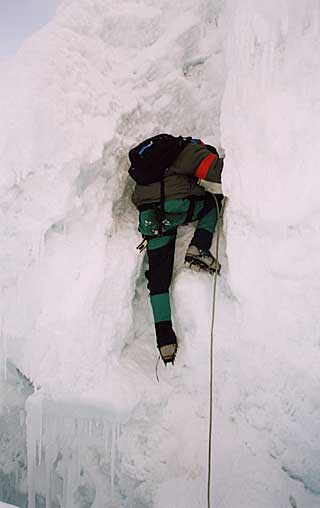
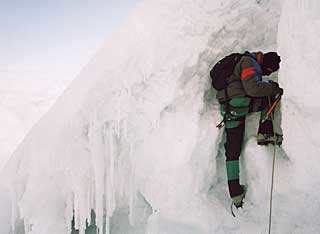
But the worst of it was when we reached the last crevasse. Not only was there a narrow snow bridge to cross, but it then required scaling up an off-center ice chute to the left (i.e. if you fell, it's into the deep crevasse, not back onto the snow bridge).
I don't think I can give an adequate representation of the fear involved in climbing this thing. My heart rate soared to dangerous levels as I was locked in what felt to me like a life and death struggle to survive. While this kind of obstacle may be child's play to the likes of Ivan and other expert climbers, Pascal and I don't belong in this category.
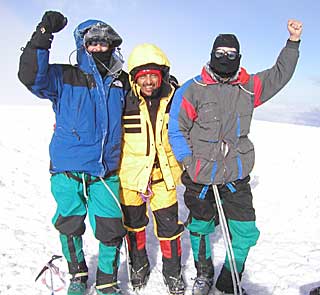
Forty-five minutes later, at 8:45 AM, seven and a half hours after leaving the refuge, Pascal and I staggered to the top of Cotopaxi.
We made it!!! We had just successfully climbed the world's tallest active volcano. At 19,350 feet, that's about 5,000 feet higher than any mountain in the continental US!
While cloud cover prevented us from seeing the crater, that didn't even matter. We knew it was there, and we had made it. Pascal and I took a few pictures, but didn't stay long. It was so cold and windy that Pascal lost all sensation in his hands.
It would have been great if a helicopter could have then just whisked us back down to the refuge for hot chocolate and a warm bed. Unfortunately, that's not how it works. Every single step we took to come up had to be retraced all the way back in the opposite direction.
This is sheer torture. While climbing up a mountain is highly exerting, and we'd given our all to make it to the top, climbing down also requires a lot of effort--and even more concentration. Slipping on the way up makes you fall on your face, but slipping while facing down is quite another story.
The worst, by far, was that ice chute. If climbing up this thing brought fear, scaling down caused sheer panic. There was no way to see where your feet were going and what kind of traction they'd find. The only thing we were certain of was that there was one big crevasse right below just waiting for that slip. Personally, I've never been so thankful for an ice axe in my life, and held onto it for dear life on more than one occasion (as you can imagine, trying to use gloves to hold on to an ice wall wasn't all that effective--though not for lack of trying!)
We did make it, obviously, and then kept going down. And down. And down. We were so fried and dehydrated that--despite the incredible scenery--neither of us had the energy to pull the camera out of our pocket and take a picture. That extra movement required too much effort.
The closer we got to the refuge, the worse it got. It started snowing again, but as we got closer to the refuge it got warmer and warmer, so that we were sweating heavily in our cold-weather gear. This only heightened our dehydration, and our mouths and throat were completely parched.
Although the refuge is at almost 16,000 feet, the fact that Cotopaxi is right on the equator places it just below the snow line. As we got closer, ice and snow turned to deep slush, our legs sinking to the knee with each step. Tantalizingly close to the refuge, Pascal and I several times tried to let gravity take its course and run down the mountain, only to fall 20 steps later, dead tired and panting for air, our eyes locked on the refuge and the Gatorade we knew was inside.
At 10:45 AM, nine and a half hours after we'd left, we made it back to the refuge. And immediately downed a Gatorade each. Exhausted, we packed up all of our gear and climbed down another 1,600 feet to Ivan's car for our return to Quito, an hour and a half away.
This afternoon, we basked in our first hot shower in more than 48 hours before passing out for a mid-afternoon nap. Dinner (our first meal of the day) was a large pizza--the perfect meal after a good climb.
And now, for our last night in Ecuador, we'll hit the nightclubs to celebrate!
Cheers,
Gabriel